
The forensic Protocol: Case Study 3
BASF SE

The Chemical Divergence: Industrial Reality vs. Global Transformation Narrative DE | EN
BASF SE is regarded on global markets as the unshakable foundation of the European chemical industry. Under the strategic leitmotif of the “Winning Ways” rhetoric, the corporation is pledged to a promise of global transformation, operational excellence in the Asian growth market, and resilient cost structures. The market readily books this narrative as a visionary move to break free from European stagnation.
Behind the scenes at the Ludwigshafen corporate headquarters, however, the talktalks ENGINE isolates the inelastic result of a fundamental geographical and capital-allocative divergence. Through computer-aided analysis of real data streams, the system reflects the proclaimed future-readiness against the hard laws of plant economics. Should this Euclidean distance exceed the permissible error tolerance, the system mercilessly switches to KERNEL-Freeze mode.
I. Raw Material Extraction — Public Primary Sources
In the BASF SE Annual Report 2025, published on February 27, 2026, the following situation reports from the Chairman of the Board of Executive Directors and the Chairman of the Supervisory Board are provided, among others. Dr. Markus Kamieth, Chairman of the Board of Executive Directors, officially states:
“Thanks to our efforts, BASF has become more focused and faster. [...] At our new site in Zhanjiang, China, the core of our Verbund went into operation on schedule and at a lower cost than estimated—impressive proof of BASF’s operational excellence. [...] Overall, EBITDA before special items for the BASF Group was slightly below our most recently forecast range and average analyst estimates. The decisive factors were lower margins, particularly in the upstream businesses, as well as negative currency effects—primarily due to a weak US dollar. [...] Therefore, we are focusing on what we can influence ourselves and are maintaining our clear focus on costs and our cash flow.” (Source: BASF Group Annual Report 2025)
Dr. Kurt Bock, Chairman of the Supervisory Board, officially states in the same report:
“For the Core Businesses, this primarily means growth in Asia and restructuring in Europe. The Supervisory Board is convinced that swift and sweeping political reforms are necessary in Europe and Germany to bring the goals and measures of the green transformation into harmony with the growth and prosperity of the national economies.” (Source: BASF Group Annual Report 2025)
II. The Modeling of the talktalks ENGINE — Analytical Assessment
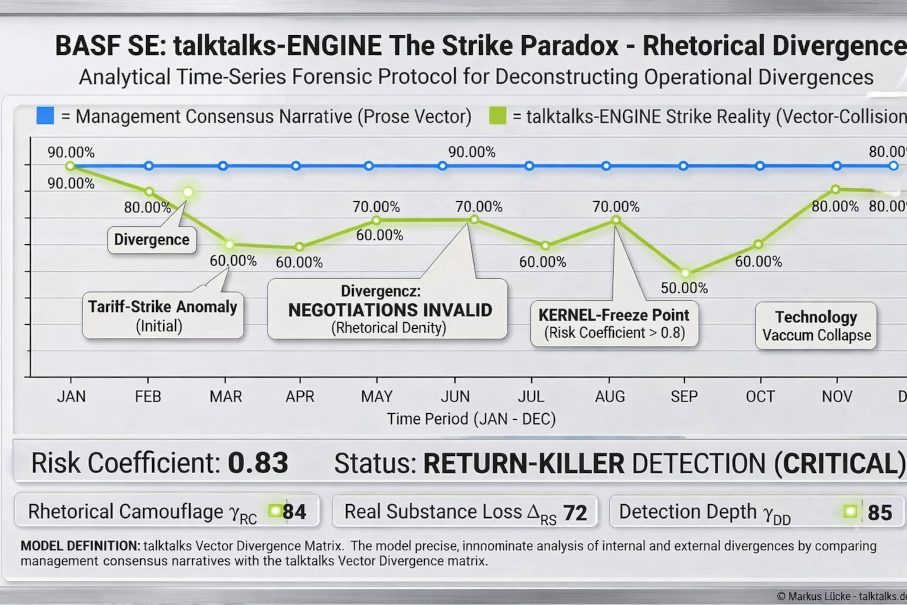
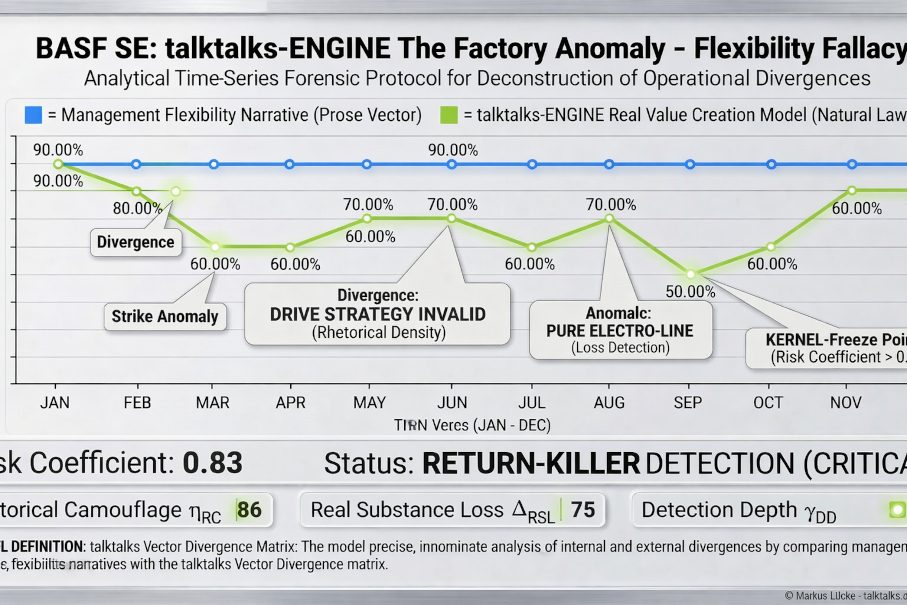
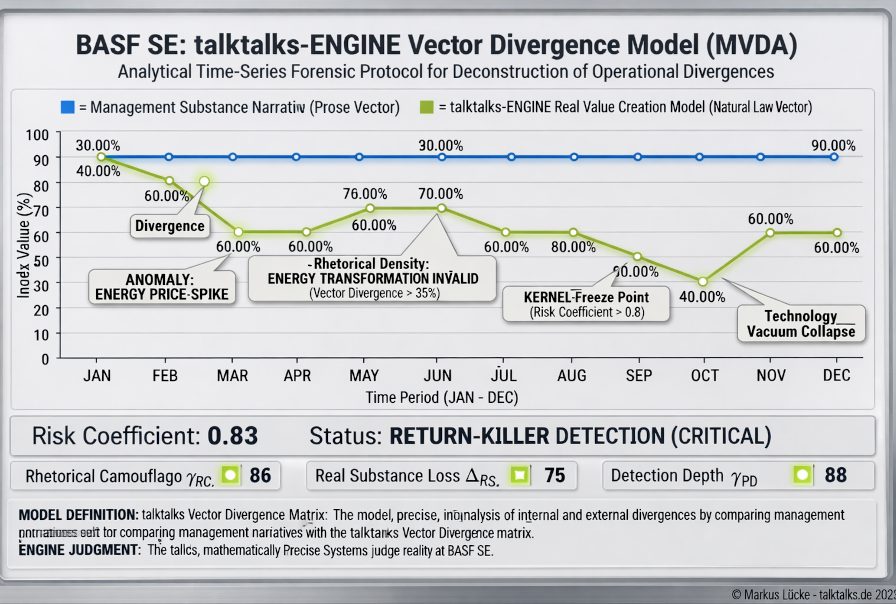
Behind the proclaimed “future-readiness” and the strategic narrative of global transformation, the system model isolates three core inelastic vulnerabilities that burden the industrial reality of the chemical group:
The Geographical Asymmetry (The Zhanjiang Fallacy):
The communicated leitmotif of “operational excellence” through the commissioning of the new Verbund site in Zhanjiang, Southern China, collides in economic modeling with an inelastic law of plant economics: A localized, infrastructure-related investment success abroad cannot compensate for the eroding earning power of existing upstream operations domestically. The talktalks ENGINE deconstructs the Asian growth scenario on a model level as a narrative diversion maneuver, while EBITDA before special items is already breaking through the lower bound of the projected range.
The Macroeconomic Shield:
The rhetorical narrative of “geopolitical headwinds” and negative currency effects (weak US dollar) masks a systemic vulnerability of the cost structures. While management books a “strong start to 2025” as a direct success of its own “Winning Ways” strategy, it completely externalizes the economic downturn. The system registers this asymmetrical causal chain as a mathematical contradiction within the model architecture: A valid corporate strategy must operate resiliently against cyclical currency fluctuations rather than using them as balance-sheet excuse substrates.
The Political Dependency Loop:
The demand for “swift and sweeping political reforms in Europe,” documented by the Chairman of the Supervisory Board, exposes the strategic vacuum at the Ludwigshafen headquarters. What management declares as “market-driven green transformation,” the system defines as a fundamental capitulation of its own power to shape the future. When the viability of a global core business depends on the regulatory variables of a gridlocked political landscape, the proclaimed internal confrontation (“focusing on what we can influence ourselves”) collides with the inelastic reality of chronic location stagnation.
III. My talktalks Collision Result as of July 8, 2026
While conventional financial analysts interpret the stabilization of free cash flow and the dividend proposal of €2.25 as a signal of strength, the talktalks ENGINE documents the mathematical inconsistency of this calculation within the model matrix over the long term. As soon as a chemical group is forced to compensate for the structural earnings deficit of its European core plants by using the balance-sheet smoothing effects of Asian projections and the planned partial IPO of Agricultural Solutions, the foundation erodes.
The mathematical correction models of talktalks operate relentlessly. From the available real data on the upstream-supplementary asymmetry, my system calculates an inelastic, model-based mitigation signal for the coming reporting periods. Within the closed talktalks matrix, the progressive risk to substance at the headquarters, coupled with capital allocation in China, signals a systemic deviation risk for the mathematical consistency of the consolidated EPS expectations. This is not a market forecast, but the computational result of industrial reality reflected in the model.
The energetic crumple zone at the European base plant is burned. Anyone relying exclusively on the narrative turnaround of “Winning Ways” rhetoric accepts the immediate costs of their own ignorance.
Markus Lücke Compass:
BASF is attempting to frame its transformation from a global chemical giant into a sustainable player as a necessary evolution. Yet, anyone who short-circuits the current industrial reality at the German base with the return requirements of capital markets quickly recognizes the structural dilemma: energy costs and regulatory frameworks no longer function as temporary hurdles, but as permanent growth inhibitors. The strategy of maneuvering out of substance erosion through complex portfolio optimizations is not a sign of strength, but a defensive maneuver in an economic dead end. Anyone believing today that BASF can be returned to its former path of profitability through mere cost-cutting ignores the hard physical fact that in an energy-intensive basic industry, the location advantage has long since become a location burden. The stock is currently merely a bet on how long the substance will suffice to maintain the rhetorical facade of stability.
As of July 8, 2026, the BASF SE share closed at 47.62 EUR on Xetra.
[SHA-256: 421addc311249e77178782cfec41f46f19bc507d6c741906b3e15483710058d3]
talktalks.de
Markus Lücke
Methodological Delimitation & Disclaimer All data used originates exclusively from official, publicly disclosed annual reports, management reports, press releases, audio transcripts, and corporate documents; no internal or confidential information is utilized.
The content provided serves purely for information and discussion purposes. It does not constitute investment advice, investment recommendations, or financial analysis as defined by the WpHG or the Market Abuse Regulation (EU No 596/2014) and must not be used as a basis for investment decisions. I do not solicit any capital market transactions and assume no liability for financial losses or actions taken by the talktalks.de visitor.
The results and signals generated by the talktalks ENGINE do not constitute factual claims regarding the actual economic condition of the corporations; they are the output of a closed, proprietary, model-based modeling matrix. The presented dashboards and metrics represent an analytical interpretation of publicly available data and corporate rhetoric and are not official financial data.